

Your tooth hurts, the dentist says “root canal,” and you look at the bill and feel faint for the second time. Sound familiar? A root canal in the USA can cost anywhere from a few hundred to several thousand dollars — without the crown, without general anesthesia, without X-rays. Meanwhile, the same procedure in a Polish dental office costs a fraction of that amount.
More and more Polish-American families are combining their summer trip to Poland with planned dental treatment. It’s not a whim — it’s a rational calculation. In this guide, we break down what makes up the cost of endodontics on both sides of the Atlantic and what determines the final amount on the bill.
What makes up the cost of a root canal — anatomy of the bill
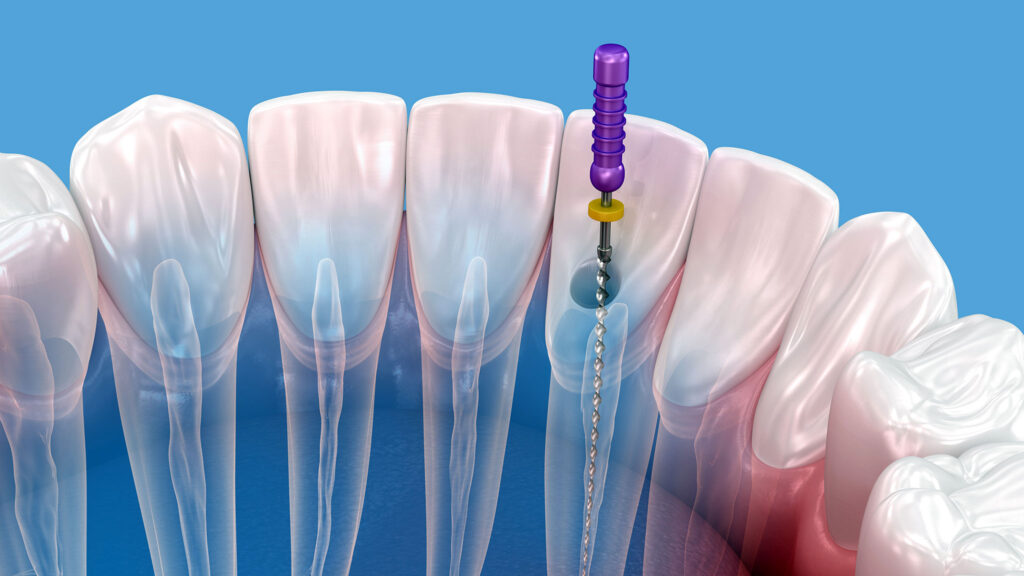
A root canal is not a single procedure, but a sequence of procedures. It starts with diagnostics — X-rays, or possibly CBCT tomography, which allows you to see the three-dimensional structure of the root canals. Next comes local anesthesia, opening the pulp chamber, removing the infected tissue, and chemically preparing the canals using sodium hypochlorite or chelating agents. Finally — tight filling of the canals and tooth restoration.
In the USA, each of these stages is often billed separately. X-rays are a separate item, anesthesia is separate, and a prosthetic crown after a root canal can cost more than the root canal procedure itself. In a Polish office, the quote more often includes a package: from diagnostics to filling, without splitting the bill into twenty sub-items.
The difference does not come from the quality of materials — Polish endodontists work with the same NiTi rotary files and sealers as offices in the States. The difference is operating costs: rent, practice insurance, licensing fees, and staff salaries, which in Białystok are many times lower than in New York or Chicago.
Factors affecting the price of endodontics — what drives up the bill
Not every tooth costs the same. Incisors (front teeth) usually have one root canal — the procedure is shorter, cheaper, and simpler. Molars are a different story: three, four, or even five canals, curved roots, narrower lumen. The dentist works longer, uses more files, and the risk of complications increases.
Another factor is inflammation. A tooth with an acute periapical abscess often requires two visits — first drainage and antibiotics, then the actual root canal treatment. In addition, there is potential prosthetic restoration: a post-and-core and a porcelain crown, which protect the weakened tooth from breaking. In the office at Kolonia Dojlidy in Białystok, the quote takes into account the number of canals and the degree of difficulty — the patient knows the cost before the procedure begins.
Looking for a trusted dentist who speaks Polish? See Polish dentists with many years of experience on PolishPages
Dental tourism in Białystok — logistics and time
Białystok is not a random choice. The city is less than a three-hour drive from Warsaw, and Chopin Airport handles direct connections from over a dozen cities in the USA and Europe. For families from Greenpoint, Ridgewood, or Polish enclaves in New Jersey, a flight with a layover in Warsaw and a trip to Białystok is a matter of one day.
The Dojlidy district, where the office is located, is a quiet, green area near the Dojlidy Reservoir. After a root canal procedure, patients can take a walk along the shore of the reservoir instead of sitting in traffic in Manhattan. Exactly — this is one of the arguments rarely spoken about aloud: treatment in a smaller city means less logistical stress, easier parking, and an office where no one rushes you out after twenty minutes.
Planning is simple: just call a few weeks in advance, describe the problem, and the office will propose a schedule of visits tailored to the length of your stay in Poland. A root canal for a single-canal tooth is often completed in one visit; molars require two appointments with a break of a few days.
What to look for when choosing a dentist for a root canal
- Experience in endodontics, not just the title. The title “dentist” is a starting point, not a guarantee. Ask how many root canal procedures the office performs per month and how many years they have been performing endodontics. A dentist with over thirty years of experience has had thousands of teeth in their hands — that makes a difference with the curved canals of a lower fourth tooth.
- Communication before the procedure. A good office will explain exactly what will be done, how many visits you need, and how much you will pay — before you sit in the chair. Avoid places where you get the quote after the fact or “by eye”.
- Approach to patient anxiety. Endodontics is a procedure that causes fear. An office that takes the time to calm you down and doesn’t rush, explaining the procedure step-by-step, saves you nerves. Patients with dentophobia should look for a dentist who talks openly about comfort during the procedure, rather than dismissing it with “it won’t hurt”.
- Modern diagnostic tools. A point X-ray is the absolute minimum. Offices using optical magnification (loupes, microscope) and electronic canal length measurement (apex locator) have a statistically higher percentage of correctly filled canals. Ask about the equipment — you aren’t ashamed to ask a mechanic for computer diagnostics for your car, right?
- Transparent pricing broken down by stages. The bill for endodontics should clearly indicate what it includes: diagnostics, anesthesia, canal preparation, filling. An office that offers a price “for the entire root canal treatment” including the post-procedure check-up gives you peace of mind and financial predictability.
The dental office of Dr. Izabela Skok-Bosko from Białystok meets these criteria — check the full endodontics offer and patient reviews
When a root canal is the only way out — and when it can be avoided
Not every toothache leads to the endodontist’s chair. Short-term sensitivity to cold drinks after a large filling is not yet an indication for a root canal. Warning signs are rather spontaneous pain (especially at night), prolonged reaction to heat and cold after the stimulus is removed, gum swelling over the root, and discoloration of the tooth crown.
In short — the sooner you react, the less you pay. Cavities treated at the stage of a shallow lesion end with a simple composite filling. Cavities that have reached the pulp require endodontics. And a tooth with dead pulp and an abscess under the root means endodontics plus prosthetic restoration — and a bill three times higher than a regular filling. That is why regular check-ups every six months are not a whim, but the best investment.
Don’t wait until the pain decides for you. Call the office of Dr. Skok-Bosko in Białystok and schedule a consultation before your trip to Poland: 011-48-514-391-988
Every situation is different — consult a licensed dentist.


