Stone bathroom elements follow a set order: choose the sink, faucet and tub, have the plumber run supply and drain lines, install the vanity cabinet or tub frame, measure, and only then cut the stone. Price depends on the stone, how many pieces share one slab, cutouts, edges and access.
A vanity top, a tub deck, a stone base, a threshold, a niche shelf or a shower seat: one bathroom can include several stone pieces. Each one meets the plumbing, the tile or the fixtures, so none of them is made in isolation from the rest of the remodel. That sets a bathroom apart from a kitchen, where the countertop is usually one large order.
That is exactly why sequence matters so much. If the plumber roughs in the drain in the wrong spot, or the faucet is chosen after the vanity top is cut, the fix means a new stone piece and sometimes tearing out fresh tile. This guide shows how to plan the work, which dimensions to settle in advance, what drives the estimate and how to choose a fabricator.
Vanity top, tub deck and base: how do they differ?
A vanity top sits on a cabinet or console and has an opening for the sink, whether undermount, drop-in or a vessel sink that rests on top. Then come the faucet holes, which depend on the faucet type: single-hole, three-hole widespread or wall-mounted. Many people also order a low stone backsplash and side splashes to protect the walls from splashing.
A tub deck is the stone surface surrounding a drop-in tub. It creates a handy ledge for toiletries and an edge you can sit on while stepping in. It may be finished with a vertical front panel, or apron, and holes for a deck-mounted tub faucet. Granite, quartz or stone composites shaped to fit the tub are common choices for decks.
A stone base is a supporting or decorative element under a countertop or sink. It can be made of granite or engineered stone, in a color that matches the top or deliberately contrasts with it. For vanity tops, Carrara marble is a frequent pick in traditional rooms, quartzite for its durability and engineered quartz when a uniform look and easy care matter most.
In what order do the plumber, tile setter and stone fabricator work?
First, pick the specific sink, faucet and tub. Without them, the plumber does not know at what height to set the drain and supply lines, and the fabricator cannot lay out the cutouts. Keep the manufacturers’ spec sheets in one folder and share them with every crew.
Next, the plumber roughs in the lines, and the vanity cabinet, base or tub frame goes in, along with the tub itself. Only then is the stone measured. After shop fabrication, the stone is installed, and finally the plumber hooks up the fixtures and seals the connections. Agree with the tile setter ahead of time whether wall tile stops at the stone or the stone tucks under the tile, because that determines the order of their work.
Check the paperwork while you are at it. In New Jersey, the ordinary maintenance rules (N.J.A.C. 5:23-2.7) exempt from permits, among other things, replacing a fixture with a similar one when the piping arrangement does not change, as well as replacing faucets. Moving a drain or supply lines falls outside that category, so before such a change ask your local construction office whether a permit is needed.
Which dimensions should be settled before measuring?
The first is vanity height. A vessel sink raises the rim where you wash your hands, so the cabinet under it usually needs to be lower than one with an undermount sink. Fit the height to the people in your home, not to a catalog: a tall adult and a child use the bathroom very differently.
The second is depth and overhang. Decide how far the top should extend past the cabinet front, how much room is left between the faucet and the wall and whether you can easily wipe water away back there. For a tub deck, what counts is the width of the ledge around the tub and whether it leaves enough space for toiletries and comfortable sitting.
The third is service access. A whirlpool tub or valves hidden under the deck need an access panel in a reachable spot. Its position and size must be planned together with the stone, because cutting an opening in a finished deck is a headache. Sound familiar? Plenty of homeowners only think of it when the pump fails for the first time.
What determines the cost of stone bathroom elements?
The material comes first. Granite, quartzite, quartz, marble and travertine differ in price, and within one type of stone the color, pattern and slab thickness matter too. If several pieces in the bathroom should share the same pattern, the fabricator has to fit them into one or two slabs, which affects layout and waste. Small vanity tops can sometimes be cut from remnants of larger slabs, so ask whether that option is available.
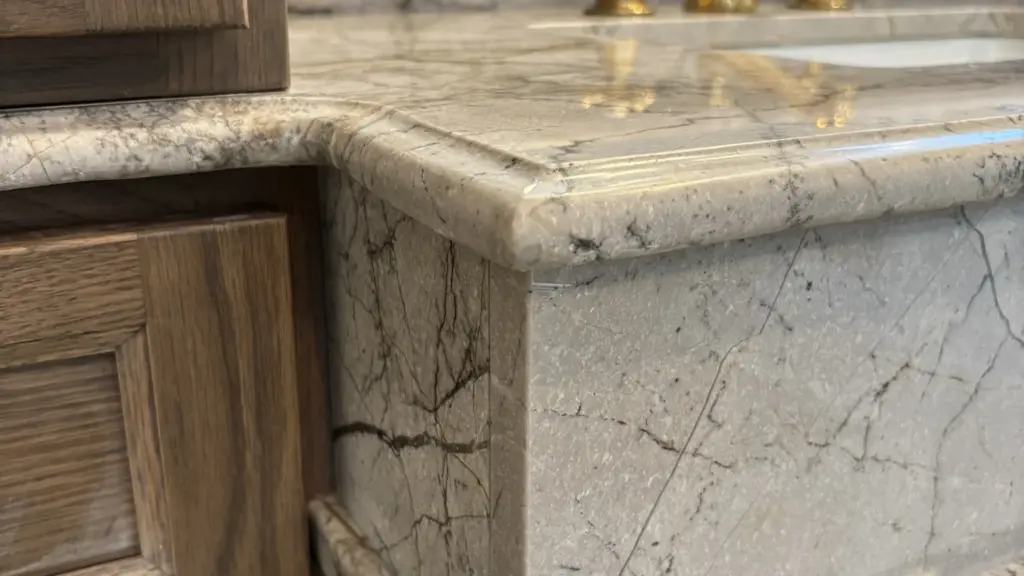
The second group of factors is the number and complexity of pieces. A single-sink vanity top is priced differently from a full set: a top with side splashes, a tub deck with a front panel, a base, a threshold and niche shelves. Every cutout is labor: an undermount sink with a polished opening, several faucet holes, an oval tub opening or an access panel. Exposed edges must be ground and polished, and their profile affects the cost as well.
The third group is installation conditions. Narrow stairs in a rowhouse, a second-floor bathroom with no elevator, removing an old tiled tub surround or a long drive all change the amount of work. Keep in mind that the plumber’s work is usually a separate item, billed by another contractor.
Want to find out which stone suits your bathroom? Call and book a free consultation, available in Polish: 609-608-5750
An older house or a New York apartment?
In homes with a long history, for example in Trenton, Hamilton or Doylestown in Bucks County, walls are rarely perfectly straight and floors may slope slightly. Stone needs a stable, level foundation, so the cabinet and tub frame must be set with great care before anyone starts measuring. With narrow hallways and steep stairs, consider splitting the tub deck into two pieces with a seam.
In New York buildings, board rules come into play. Shutting off water to a riser usually has to be arranged with management or the super, work may be allowed only during set hours and bringing in slabs requires an elevator reservation. That’s not all: bathrooms in Manhattan apartments can be so small that every inch of the vanity top and tub deck has to be planned in advance.
If you are redoing the kitchen along with the bathroom, you can order stone for both rooms from one fabricator and line up the measurement dates. Also read how to order a stone kitchen countertop to prepare for both orders at once.
What makes a good bathroom stone fabricator?
Bathroom stone pieces are smaller than kitchen countertops, but they require more fitting around plumbing and fixtures. A good fabricator will ask about your fixture models before quoting a price.
When comparing offers, check these five things.
- Years of working with stone. Find out how many years the company has worked with marble and granite, and ask to see photos of bathrooms it has completed. Experience shows in precise sink cutouts and even seams around the tub.
- All the pieces from one shop. It is convenient when all the pieces come from one shop. The stone then matches in color, and the vanity top, tub deck and base are made to measure by a single fabricator.
- A chance to compare several stones. Marble, quartzite and engineered quartz behave differently in a bathroom. A fabricator who works with many materials can help match the stone to your habits, not just to the color of the tile.
- An estimate at no cost. A reliable quote is prepared after seeing the bathroom or from a detailed drawing, and it should cost you nothing. Ask for each piece and cutout to be listed separately.
- Conversations in Polish. With so much to coordinate with the plumber and the tile setter, misunderstandings come easily. If it is easier for you to go over details in Polish, choose a fabricator who makes that possible and travels to your area.
Euro 1 Countertops Granite & Marble, Inc. in Ewing meets these criteria — read customer reviews and view the company profile. Sample vanity materials are shown on the company’s vanity tops page.
Which mistakes should you avoid when planning bathroom stone?
The most common mistake is ordering the vanity top before choosing the faucet. The number and spacing of holes depend on the specific model, and changing your mind after cutting means a new top. The same goes for a vessel sink set on a standard cabinet: it is easy to end up with a basin at a height that is simply uncomfortable.
The second mistake is measuring for the tub deck before the tub is set and leveled. Even a small shift of the tub means the opening in the stone no longer fits. Also ask the fabricator how water will drain off the deck surface so it does not collect in the corners by the wall.
The third mistake is choosing material without thinking about who will use the room. Polished marble in a kids’ bathroom, where toothpaste and water fly everywhere, needs more attention than quartz or granite. The point is not to give up on marble but to decide knowingly and plan the upkeep.
A stone bathroom takes more planning than one finished in tile alone, but that effort pays off at installation. Once the fixtures are chosen, the plumbing is in place and the cabinet and tub are set, the stone can be measured and installed without rework.
Start with a list of fixtures and a simple drawing of the bathroom with dimensions, then show them to the plumber and the stone fabricator at the same time. One joint meeting often spares you weeks of frustration.
Talk to an expert — call: 609-608-5750
This guide outlines general planning principles; permit requirements, dimensions and scope of work should always be confirmed for your specific building.