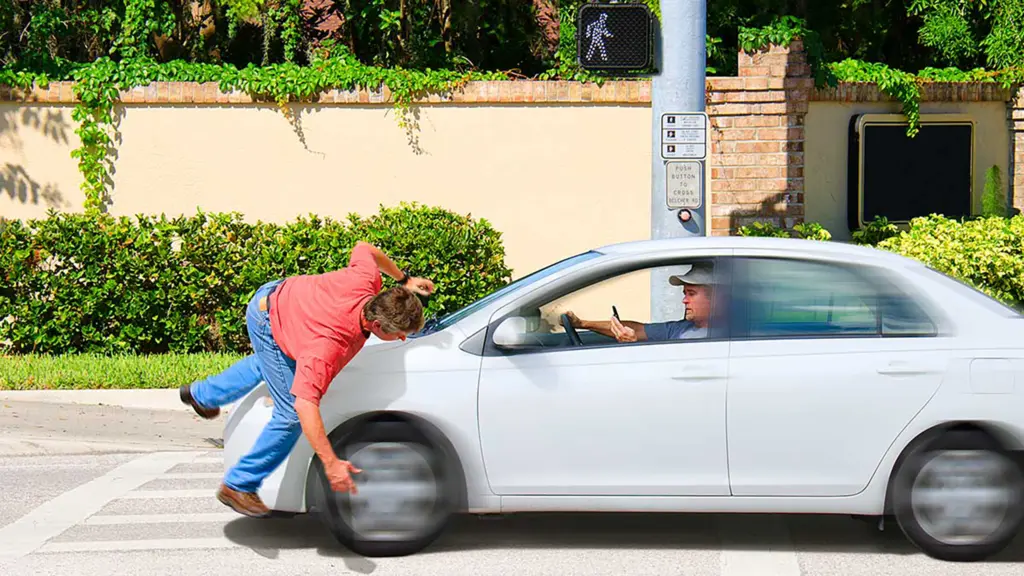
A pedestrian struck by a car in New York is entitled to no-fault benefits from the policy on the vehicle that hit them — covering medical treatment and part of lost earnings, regardless of fault. If the driver fled or had no insurance, a state fund can step in.
A pedestrian always loses the physical contest: no bodywork, no airbag, no seat belt. Fractures, head injuries and weeks away from work are a typical outcome even at low speed. And right after the injury comes the second blow — the questions. Who pays for the emergency room and the rehabilitation when I do not own a car or a policy, what if the driver simply drove off, and am I owed anything at all if I stepped into the road outside the crosswalk?
The good news is that the New York system is kinder to pedestrians than most of them realize. The bad news is that using it depends on deadlines that begin running in the first hours after the event. This guide explains where a pedestrian’s benefits come from, what to do after a hit-and-run, and which decisions in the first week carry the most weight.
Where does a pedestrian with no policy get benefits?
Against intuition, a pedestrian does not need auto insurance of their own. Under the New York no-fault system, a pedestrian struck by a vehicle — and a cyclist as well — receives benefits from the policy covering the vehicle that hit them: medical costs and a portion of lost earnings, regardless of who was at fault. The framework is described by the New York State Department of Financial Services. The condition is timely presentation of the claim — the no-fault application is due within a period measured in weeks, not years.
No-fault benefits are only the first layer, though. For pain, suffering and lasting consequences, a pedestrian may additionally sue the driver. New York requires proof of a “serious injury” as defined by the insurance law, which in pedestrian cases is assessed separately on its own medical record. That claim is directed at the driver’s liability coverage, and its value turns on the medical records and the long-term effects of the injury.
How fault is assessed matters as much as where the money comes from. A pedestrian in a signalized crosswalk starts from a strong position, but even stepping into the roadway outside the crosswalk does not extinguish the claim — New York applies comparative fault, so any contribution by the pedestrian reduces the recovery rather than eliminating it. Drivers, for their part, carry a statutory duty to yield to pedestrians in crosswalks and to exercise due care.
The same logic extends to cyclists and to people on scooters struck by a car; they too may draw no-fault benefits from the striking vehicle’s policy — depending on how their own vehicle is classified. The line is drawn at motorized vehicles: anyone operating a motorcycle or a moped is governed by different rules — something a number of injured riders discover only after the fact.
Who covers the costs when the driver flees or has no insurance?
Drivers leaving the scene is common enough in New York that the system built a separate answer for it: a guaranty fund for victims of unidentified and uninsured motorists, created under state law. A pedestrian with no auto policy in the household to pick up the claim can seek benefits from that source instead.
The catch lies in the formal conditions. Reporting the collision to the police promptly is decisive — in practice hours matter, not days — along with documentation that the driver could not be identified. People who “didn’t want to make trouble” and never called the police close off access to the fund with their own hands. So do those persuaded by a driver to settle the matter with cash at the curb.
If the pedestrian lives with someone who carries auto insurance, the uninsured motorist coverage on that household policy may also come into play. Identifying the correct source of benefits is standard work for a lawyer — and because these cases are handled on a contingency fee, with a free consultation and a fee paid only on recovery, checking the options costs nothing.
In hit-and-run cases, cameras play an outsized role: municipal cameras, store cameras, doorbell cameras and dashboard recorders. Footage can identify a vehicle long after witnesses have run out of useful memory — provided somebody requests it before the system overwrites it. That is one more argument for putting the case in professional hands in the first days rather than “when health permits.”
Call for a free review of the benefit sources available after a pedestrian collision: 347-563-2605
The New York street: where and why pedestrians get hit
New York has run its Vision Zero program for years, aiming to eliminate traffic deaths — the city rebuilds intersections, lowers speed limits and publishes maps of dangerous corridors at nyc.gov/visionzero. Daily life in the neighborhoods remains demanding all the same: delivery trucks backing up without a spotter, turns made across crosswalks on a pedestrian signal, e-bikes and courier scooters on sidewalks.
In the Polish neighborhoods of Brooklyn and Queens — along Manhattan Avenue in Greenpoint, on Fresh Pond Road in Ridgewood, around Grand Avenue in Maspeth — foot traffic mixes with heavy delivery traffic. Collisions also happen in supermarket parking lots and at exits from car washes and gas stations, where drivers watch the roadway rather than the sidewalk. The law treats those events every bit as seriously as collisions at intersections.
A newer category of at-fault vehicle is micromobility: e-bikes and courier scooters capable of knocking a pedestrian down on the sidewalk. These cases can be harder on the insurance side than conventional car collisions, which makes it all the more important to establish who the courier was riding for and what policies stand behind the employer or the delivery platform.
A separate category is pedestrians struck on the way to work or in the course of it — a loading dock worker hit by a reversing vehicle, for example. There, workplace injury benefits arise alongside the road claim, and sometimes the liability of additional parties; the overlap resembles the situations described in our guide to construction accidents and workers paid in cash. For the rules and deadlines governing vehicle collisions themselves, including New Jersey, see our guide to how New York and New Jersey differ after a car accident.
What to look for when choosing a lawyer for a pedestrian case
- Command of benefits for non-drivers. Pedestrian cases run on a different arrangement of policies than car-to-car collisions. The attorney should identify every potential source of benefits at once, including the guaranty fund.
- Speed when the driver has fled. Securing store and municipal camera footage and locating witnesses is a race against the clock. What counts is a firm that starts on day one.
- Experience with severe injuries. Pedestrian collisions frequently mean head injuries and multiple fractures. The lawyer has to work effectively with physicians and experts to document consequences that last for years.
- An honest approach to comparative fault. A good attorney does not dodge the question of crossing outside the crosswalk; they explain how comparative fault will affect the case and what can be done about it.
- Conversation in your own language with the attorney handling the file. The circumstances of the collision and the course of treatment have to be described precisely, and details relayed through a translating relative tend to go missing.
Jodré Brenecki, LLP, in Williamsburg, meets these criteria — read the firm’s full profile and client reviews.
The first 72 hours — the mistakes that cost the most
Mistake number one: no police. Without a report there is no foothold for the insurance carrier or for the guaranty fund after a hit-and-run. Mistake number two: declining medical help at the scene and going home to sleep it off. Head injuries and bleeds can surface hours later, and the absence of records from the day of the event weakens a case more than anything else.
Mistake number three: talking to the driver’s insurance carrier unprepared and signing documents whose content is unclear. And mistake number four: putting off the no-fault filing because “treatment first, paperwork later.” The paperwork has its own deadlines, and they are shorter than the treatment.
There is also a quieter error — assuming that because the driver stopped and seemed decent, the matter will resolve itself. Decency at the curb and the position an insurance carrier takes six weeks later are unrelated things, and only one of them is written down.
A pedestrian who has been struck is not defenseless. The New York system provides benefits without regard to fault, a path to a lawsuit for serious injuries, and a fund for hit-and-run cases. All of those doors, however, open only for people who take care of the reporting and the documentation from the first hours.
Talk about your case with an attorney, in Polish or English: 347-563-2605
Every situation is different — this guide is for general information only and is not legal advice. Attorney Advertising. Consult a licensed attorney about your individual case.