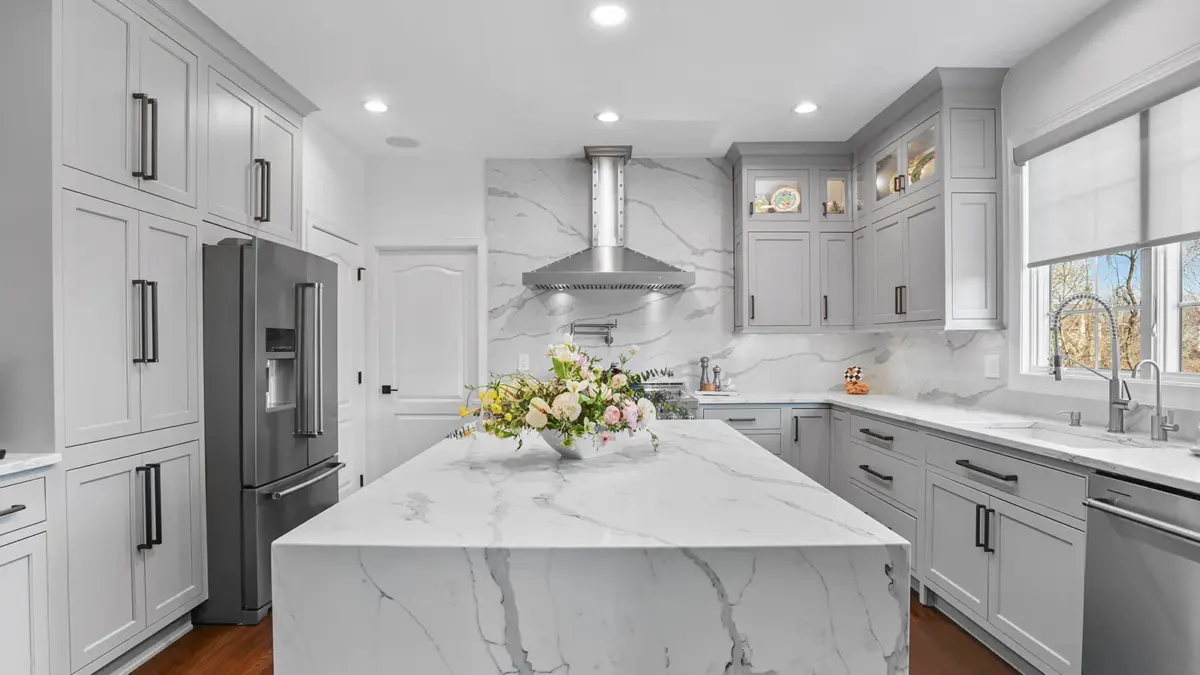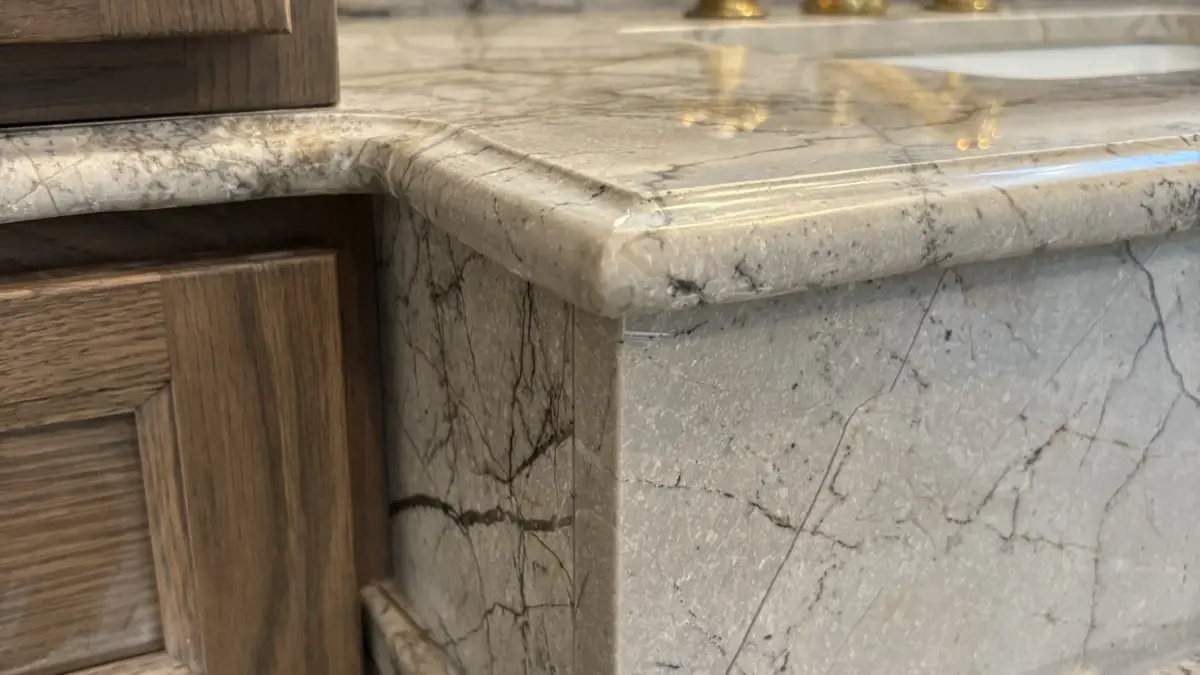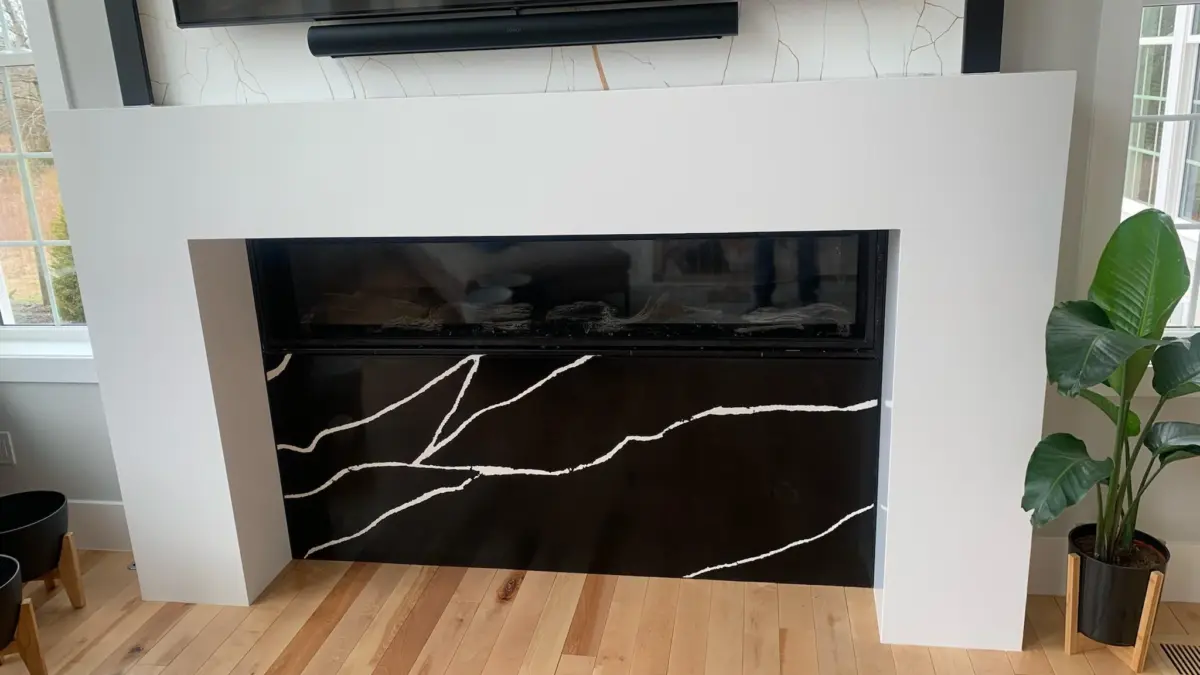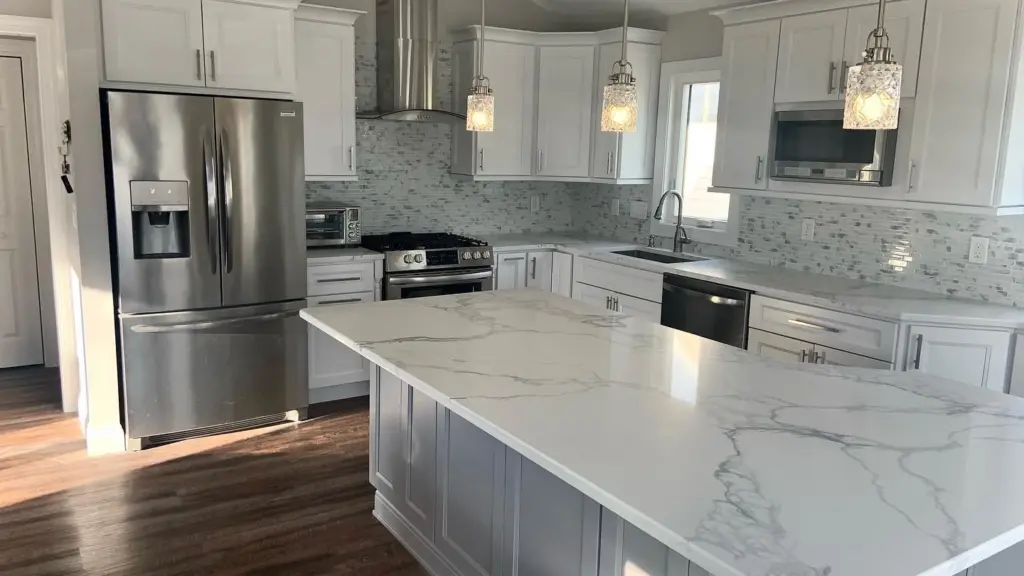
To order a stone bar top or table, first settle seat height and overhang depth, then how the slab will be supported. Next, pick the material, thickness and edge profile. Price depends on the stone, number of slabs, cutouts, brackets, edge work, and how hard delivery and installation are.
A bar top looks simple: a piece of stone extending past the cabinets, a few stools, done. In reality it is one of the more demanding structures in a kitchen. Stone that cantilevers beyond the cabinet box behaves differently from a counter resting flat on its base, and people sitting at a bar lean on it with elbows and forearms, sometimes with their full weight. A stone table, on the other hand, is a piece of furniture seen from every angle, with edges exposed all the way around.
That is why it helps to answer a few questions before you call a fabricator. Who will sit there, and for how long? Is this a basement bar in Hamilton, an island in an open-plan kitchen in Princeton, or a counter in a Trenton café that holds mugs and trays from opening to close? Almost everything that ends up on the quote follows from those answers.
How do you plan the overhang, support and thickness of a bar top?
Start with the people, not the stone. Measure the stools or chairs you plan to use and check how much knee room seated guests need. That sets the counter height and how far the slab should extend past the cabinets. Too little overhang and knees bump into the cabinet doors; too much without support and the stone risks cracking near the cabinet edge.
Which brings up support. How far stone can extend without extra structure depends on the slab type, its thickness and the material manufacturer’s guidance, so there is no single number that fits every project. For larger overhangs, fabricators use hidden steel brackets, flat bars set into the cabinet structure, columns, legs, or a vertical stone panel known as a waterfall side. Ask the fabricator to spell out the support method in the quote rather than writing just “bar top.”
Slab thickness is a trade-off between looks, weight and price. A thinner slab is lighter and easier to carry in, but with a longer overhang it more often needs brackets. A thicker slab looks more substantial and carries load better, yet it weighs more and costs more. You can also get the look of a thick edge by laminating a strip of stone underneath or by mitering pieces so the seam falls right on the corner.
Edges and surface finish
At a bar, the edge gets touched constantly. A sharp, square edge chips sooner and digs into forearms, so seating areas often get an eased or rounded profile instead. More decorative profiles look great on tables but take more fabrication time.
The surface can be polished or honed. A polished finish brings out the pattern and wipes clean easily, while a honed finish cuts down glare but, on some materials, shows greasy marks more clearly. If you can, look at a sample in both finishes under the same lighting you have in your kitchen or dining room.
Which material for a bar, and which for a table?
Granite handles heavy traffic well. Quartz, an engineered stone, has a uniform color, which makes it easy to match several tops, such as a whole set of restaurant tables. Marble brings elegance, but as a carbonate stone it reacts to acidic liquids, so a cocktail bar in marble needs discipline. Quartzite, a natural stone that often resembles marble, is a pick for people who want a similar look with more resilience in daily use.
What determines the cost of a stone bar top or table?
Material comes first. Different stones, and even different lots of the same granite, carry different prices, and rare patterns or large-format slabs cost more. Then there is the number of slabs the project needs: a long bar top that does not fit on one slab requires a seam, and every seam means extra labor and a decision about where it lands.
Fabrication is the second group of factors. Thickness, laminated edges, mitered joints, edge profile and the number of exposed sides all change the scope of work. On a table, the entire perimeter is finished, not just the front edge as on a counter set against a wall. Every cutout, such as one for a bar sink, a cooktop in the island or a cable grommet, adds another line to the quote.
The third group is structure and logistics. Steel brackets, columns or a waterfall side raise the cost but are often unavoidable. Access counts too: narrow basement stairs, no elevator, no parking in front of the building, or the need to work in a restaurant after hours. Do not forget removal of the old top and any cabinet adjustments if the base is not level.
Got your measurements and a list of questions ready? Call for a free consultation in Polish: 609-608-5750
A house in New Jersey, an apartment in New York or a restaurant: what changes with location?
In single-family homes around Mercer County and in Bucks County, Pennsylvania, a bar in a finished basement is a popular project. That’s the catch: the challenge usually is not the top itself but getting it there: tight, winding stairs and a low ceiling can rule out one long slab. Sometimes it is smarter to plan two pieces with a well-hidden seam from the start than to fight the delivery later.
In Manhattan apartments and elsewhere in New York City, building rules come into play. Ask the managing agent about permitted work hours, elevator reservations and paperwork required from contractors before you set an installation date. Give the fabricator the elevator and door dimensions at the quoting stage, since they may decide whether a table top can be made in one piece. If your bar top extends the kitchen counter, also read our guide to ordering stone kitchen countertops.
In restaurants, dust from stone fabrication matters too, so ask the fabricator which cutouts and edges will be done in the shop and what, if anything, will be cut at the installation site.
What should you look for when choosing a fabricator?
A bar top or table forgives fewer mistakes than an ordinary work surface, because people see it up close and from several sides. So judge a fabricator not only by price but by how they talk about structure and material.
These criteria will help you compare offers and ask the right questions during the first conversation:
- Experience with stone fabrication. Overhangs, mitered joints and edges exposed all the way around take skill. Ask how long the company has worked with granite and marble, and request photos of similar projects.
- Custom fabrication. A bar top rarely matches stock sizes. The fabricator should cut and finish the slab to fit your cabinets, base and stools, rather than bending your design to whatever is in the warehouse.
- A range of materials to compare. It helps to see granite, quartz, marble and quartzite side by side. Only a live comparison shows how they differ in pattern and finish.
- Communication in your language. Details of the overhang, support and cutouts are easy to misunderstand. Being able to go over them in Polish makes it easier to catch a mix-up before the slab goes under the saw.
- A free estimate and consultation. An accurate quote requires a site visit or precise measurements. Use a free consultation to compare a few material and thickness options with no obligation.
Euro 1 Countertops Granite & Marble, Inc. of Ewing meets these criteria — see the company’s PolishPages listing.
Common mistakes when ordering a bar top or stone table
The first mistake is measuring before the cabinets or table base are installed and leveled, because a correction after the slab is cut often means a new one.
The second mistake is choosing with your eyes alone. A typical case: marble that looks stunning in a catalog will show dull marks quickly at a bar serving citrus cocktails if nobody wipes it right away. Likewise, a very sharp edge next to the seats collects chips. Natural stone also varies from slab to slab, so whenever possible, look at the actual slab your top will come from. You can also browse the page with sample materials for table tops.
The third mistake involves timing. The weeks before the holidays and big family celebrations are especially busy in the remodeling trade, and plenty of people want a new island before Christmas Eve or a First Communion party. Plan the measurement and slab selection with time to spare, and in a restaurant, schedule installation for the day when closing the dining room hurts business least.
Before you call: what to prepare
Take a few photos of the space, note the dimensions of the cabinets or table base and the height of your stools, and if you live in an apartment building, check the elevator and door sizes. Think about whether you prefer a calm stone or one with a strong pattern, and whether the people at the counter will be kids, restaurant guests or mostly adults having coffee.
With that information, the conversation with a fabricator goes faster and the quote is more accurate. You can also ask for two options right away, say granite and quartz in the same thickness, to see the cost difference in black and white. You can go over the details of your project with Euro 1 Countertops Granite & Marble, Inc..
Talk to an expert — call: 609-608-5750
This guide offers general information about ordering stone surfaces. The allowable overhang, support method and slab thickness are determined by the fabricator for the specific material and installation site.