Attorney Advertising
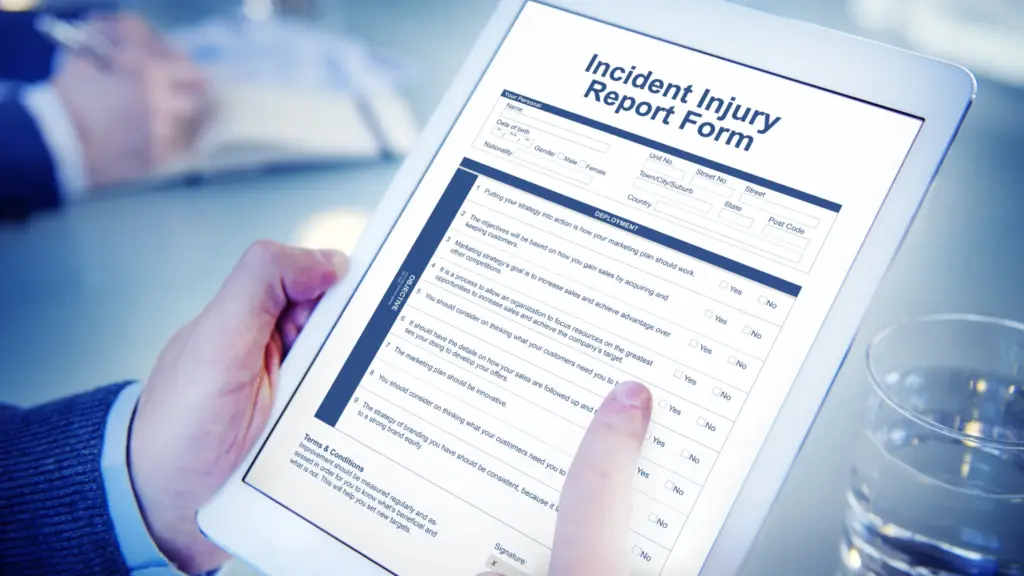
In New York, a work injury must be reported to your employer within 30 days, ideally in writing and right away. You also file your own claim with the Workers’ Compensation Board on Form C-3, generally within two years of the accident. Your employer may not punish you for reporting.
A twisted ankle on scaffolding in Williamsburg, back pain after hauling crates at a Maspeth wholesaler, a cut hand in a restaurant kitchen in Greenpoint. Many work injuries look minor at first, so the worker says “it’ll be fine,” takes a painkiller and goes back to the shift. Often there is fear on top of that: if I report this, the boss will see me as trouble, and next week there will be no work for me.
The problem is that a few weeks later the injury may turn out to be more serious than it seemed, and Workers’ Compensation deadlines keep running whether you are afraid or not. Below we explain which reports need to be made, in what order, what happens when a deadline is missed, and how New York law protects people who report an injury.
Who do you report a work injury to, and by when?
The first notice goes to your employer. Under Section 18 of the Workers’ Compensation Law, notice of the accident should reach the employer within 30 days. The statute calls for written notice, delivered in person or sent by mail. The Workers’ Compensation Board advises reporting as soon as possible rather than waiting until the end of that window.
In practice, many workers only tell a foreman or shift supervisor. That conversation counts for something, but it can be hard to prove later. So alongside the conversation, it is smart to send a short email or text with the date, time, place and a description of the injury, and to keep a copy. It does not have to be long or written in legal language.
For occupational illnesses that develop gradually – from dust, chemicals or repetitive motion, for example – deadlines are counted differently: from when the worker knew or should have known the illness was related to the job. Pinning down that date is often one of the first tasks in such a case.
Form C-3 – your own claim
Reporting to your employer is not the whole process. The employer has its own duty: to notify its insurance carrier and the Workers’ Compensation Board of any injury that is not minor – according to the Board, within 18 days of the accident or within 10 days of learning about it, whichever is longer. But the employer’s report does not replace the worker’s claim.
The worker files a separate Form C-3 (Employee Claim). According to the Workers’ Compensation Board’s guidance on filing a claim, it must be filed within two years of the accident. You can file online, by mail or in person. The Board offers free language assistance at (877) 632-4996.
Filing for Workers’ Compensation is not a lawsuit against your employer. It is a claim against an insurance system, and benefits are paid by the insurance carrier. Many people who are afraid of “taking the boss to court” do not realize the difference.
Once the form is filed, the case receives a Workers’ Compensation Board number. The employer’s carrier may accept the claim or contest it – for example, by arguing that the injury did not happen at work. In that case the Board decides, often after a hearing where the dates of your reports and your medical records carry real weight.
Does reporting an injury – or hiring a lawyer – cost a lot?
There is no fee to file Form C-3. The cost most workers worry about is the lawyer. Workers’ Compensation cases in New York have special rules here: under Section 24 of the law, the attorney’s fee must be approved by the Workers’ Compensation Board and is paid out of the benefits awarded, in the amount the Board sets.
The real cost is often waiting. A worker who spends months treating “on their own” or at the boss’s expense can end up with bills nobody wants to cover. If the injury turns out to be serious, the lack of an early report makes it harder to show it happened at work and not, say, over the weekend.
What the employer offers matters too. “I’ll pay for your doctor, just don’t report it” may sound convenient, but it does not stop the deadlines. If treatment drags on, an informal promise like that usually offers no certainty at all.
Call us and talk it through in Polish – the consultation is free: 718-383-0100
Afraid of losing your job – what does New York law say?
Section 120 of the Workers’ Compensation Law prohibits an employer from firing or otherwise discriminating against a worker because they filed a claim, tried to file one, asked for a claim form or testified in a proceeding. So the protection starts the moment you ask for the form, not only once a claim has been filed.
If retaliation does happen, the worker can file a complaint with the Workers’ Compensation Board within two years. The Board can order the worker reinstated and paid the wages lost. The firm covers that situation in more detail in its Poland.us article on being fired after reporting a work injury.
The law does not make the fear go away, of course. But it helps you plan the steps calmly: a written report with a copy kept, a doctor’s visit where you say the injury happened at work, and then Form C-3. A documented sequence of events is a worker’s strongest protection if the relationship with the employer turns sour.
What if the deadline has already passed?
Missing the 30-day window does not always end the case. Under Section 18, the Board may excuse late notice if it could not have been given for a sufficient reason, if the employer or its supervisors already knew about the accident, or if the delay did not harm the employer. The employer also has to raise the late-notice objection at the first hearing.
The two-year deadline for Form C-3 works similarly. Section 28 provides exceptions, including for occupational illnesses and cases where the carrier has already paid benefits, and the employer and carrier lose the time-bar defense if they do not raise it at the first hearing where all parties are present.
These are exceptions, though, not the rule. Any late case requires a careful look at dates, conversations and documents – and the sooner that happens, the more can be established.
How to prepare for your first conversation with The Stein Law Group
- The date and circumstances of the accident. When and where you were hurt, what you were doing at that moment and who was nearby. For an occupational illness – when symptoms first appeared and when a doctor linked them to your job.
- Proof of notice to your employer. Texts, emails, the name of the person you told about the accident and the date of that conversation. If you have not reported it yet, say so plainly.
- Medical paperwork. Emergency room discharge papers, referrals, prescriptions, doctor’s notes. It matters whether the doctor recorded that the injury happened at work.
- Employer and wage information. The company’s full legal name and address, pay stubs or other proof of earnings. Your wage-loss benefits depend on them.
- Letters from the Workers’ Compensation Board and the insurance carrier. Your case number, if you have one, and all correspondence, even if it seems confusing.
The Stein Law Group, with offices in Greenpoint and Maspeth, handles Workers’ Compensation cases in New York and New Jersey – see the cases the firm helps with.
Questions and answers
Is telling my boss verbally enough?
The statute calls for written notice, although the Board may accept a case where the employer already knew about the accident. The safest approach is to follow up the conversation with a short dated message and keep a copy.
Can I file Form C-3 if my employer never reported the accident?
Yes. Form C-3 is the worker’s own claim and does not depend on whether the employer met its reporting duty.
Can I lose my job for reporting an injury?
New York law prohibits firing or otherwise punishing a worker for filing a claim, or even for asking for the form. If retaliation happens, you can file a complaint with the Workers’ Compensation Board within two years.
Do I pay a Workers’ Comp lawyer up front?
In these cases, the attorney’s fee is approved by the Workers’ Compensation Board and paid out of the benefits awarded. The details are worth going over in your first conversation.
Reporting an injury is not an accusation against your employer – it triggers insurance that exists for exactly this situation. The deadlines are short, but with a well-documented sequence of events you can get through them calmly.
If you are unsure whether or how to report an injury, it is worth talking it over before the deadlines run out. Schedule a conversation with attorney Adam J. Stein: 718-383-0100
This article is for general information only and is not legal advice; reading it does not create an attorney–client relationship. Every case requires an individual assessment – please contact The Stein Law Group about your situation. Attorney Advertising. Prior results do not guarantee a similar outcome.